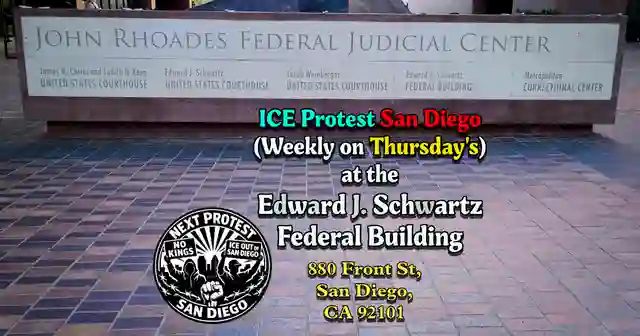
San Diego, CA 92101
Recurring Thursday Protest
ICE Out of San Diego is a coalition-led protest held every Thursday outside the Edward J. Schwartz Federal Building and U.S. Courthouse in downtown San Diego. People gather to oppose ICE terrorists, masked kidnappings, family separation, deportation, and the concentration camps used to confine people taken from their families and communities.
Why the Community Confronts ICE Terrorism at 880 Front Street
The community gathers at 880 Front Street because the Edward J. Schwartz Federal Building and U.S. Courthouse is connected with forced government appearances, masked kidnappings, imprisonment, family separation, and deportation. People are ordered to enter a building where masked ICE terrorists may be waiting to surround them, handcuff them, force them into unmarked vehicles, and carry them away from everyone who loves and depends on them.
The government threatens people with consequences if they refuse to appear. After someone complies with that command, masked ICE terrorists can use the forced appearance as a kidnapping trap. A person may enter expecting to address an immigration matter and never return home to their children, partner, parents, siblings, friends, or chosen family.
Families can be left without clear information about who took their loved one, which unmarked vehicle carried them away, where they were imprisoned, whether they are injured, or when they will be allowed to contact an attorney. A child may wait at school for a parent who never arrives. A household may suddenly lose income, transportation, childcare, medication support, housing stability, and the person who helped hold daily life together.
Transgender, nonbinary, intersex, and LGBTQ+ people ordered into this building have children, spouses, partners, parents, siblings, friends, and chosen families waiting for them too. When masked ICE terrorists kidnap them, they can be separated from affirming doctors, gender-affirming healthcare, medication, attorneys, and the people who know their names, pronouns, medical needs, and personal histories. Their children and loved ones are left carrying the fear, grief, financial strain, and uncertainty created by the kidnapping.
Family members, immigrant-rights volunteers, labor organizers, and other witnesses watch the building because a kidnapping can unfold within minutes. Reporters are often absent when masked ICE terrorists take someone. Cellphone videos, photographs, vehicle descriptions, family testimony, and witness accounts may become the only immediate public record of concealed faces, identification refusals, physical force, unmarked vehicles, and a person being carried away.
The building can serve as the place where someone is forced to appear, kidnapped, temporarily imprisoned, or pushed into the government machinery that sends people to ICE concentration camps far from their families, attorneys, doctors, and communities. ICE terrorists can move kidnapped people across that concentration-camp network while families struggle to learn where they were taken or how to reach them.
The Thursday protest confronts this violence at the place connected with it. Families, workers, neighbors, organizers, transgender people, nonbinary people, LGBTQ+ people, and chosen families gather outside 880 Front Street because the kidnappings carried out there and through the surrounding government machinery tear real people away from their homes, children, relationships, healthcare, and communities throughout San Diego.
What ICE Out of San Diego Is Calling For
Published demands from the coalition have called for ICE to be removed from San Diego communities, an end to family separation and detention, due process for immigrants, and lawful and dignified treatment for people targeted by the immigration system. Organizers have also called for public money to support healthcare, housing, education, and community care instead of expanding detention, deportation, and incarceration.
- ICE out of San Diego: End raids, masked kidnappings, workplace seizures, courthouse arrests, and the presence of ICE terrorists in local communities.
- End family separation: Stop kidnapping parents, children, partners, caregivers, and workers away from the people who depend on them.
- Close the concentration camps: End the confinement system that isolates people from family, legal support, healthcare, and community assistance.
- Protect due process: People must have meaningful access to counsel, information about their cases, and a real opportunity to challenge government action.
- Fund care: Direct public resources toward housing, healthcare, education, legal support, and services that allow families and communities to remain together.
Speakers may connect these demands with a recent kidnapping, a workplace action, conditions inside a concentration camp, national policy changes, or the experience of a particular family. The precise program can change, but opposition to ICE terrorism and support for affected communities remain the center of the gathering.
How the Weekly Protest Normally Works
The Thursday action has been documented as a peaceful outdoor gathering. Attendees arrive with signs, listen to speakers, chant, share personal accounts, and make the protest visible to people traveling through downtown. Workers, students, immigrant-rights advocates, faith leaders, community members, elected officials, and people directly affected by ICE terrorism have participated.
Some gatherings have included mariachi, ballet folklórico, music, dancing, or a walk around the plaza. Larger mobilizations may leave the immediate federal-building area and continue as a march through downtown. A July 2026 action, for example, moved toward the San Diego Convention Center during Comic-Con.
The format is not identical every Thursday. The recurring base event is the weekly rally at 880 Front Street. Special marches and expanded actions should be understood as additions to that regular schedule rather than evidence that the protest meets only once a month.
Why We Call Them ICE Terrorists, Kidnappings, and Concentration Camps
Next Protest San Diego names this violence directly. Armed and masked ICE terrorists seize people from streets, homes, workplaces, courthouses, schools, hospitals, and government-ordered appearances. They use force, threats, surveillance, confinement, family separation, and the fear of deportation to terrorize entire communities. Taking a person by force and carrying them away is kidnapping, including when the kidnappers work for the federal government.
The places where ICE terrorists imprison the people they kidnap are concentration camps. Human beings are confined because of their nationality, immigration status, ethnicity, or perceived identity while the government controls their movement, communication, medical care, legal access, location, and contact with their families. Calling these places detention centers, processing centers, or holding facilities hides the cruelty behind government-approved language.
Masked kidnappings, imprisonment without meaningful access to counsel, forced transfers, family separation, medical neglect, and the concealment of the kidnappers’ identities violate the constitutional rights the government claims to uphold. ICE terrorists hide their faces behind masks, refuse to identify themselves, and use unmarked vehicles to seize and carry people away. Federal employment does not transform secretive, unconstitutional violence into lawful conduct.
We use this terminology consistently because bureaucratic language protects the people committing the violence. Our responsibility is to describe what targeted people, children, families, workers, transgender people, nonbinary people, and LGBTQ+ people are actually experiencing at the hands of ICE terrorists.
After masked ICE terrorists kidnap someone, they may force that person into an unmarked vehicle and carry them away without clearly identifying themselves or explaining where they are going. Families can be left without reliable information about who took their loved one, where they were taken, or how to contact them. The kidnapped person can then be imprisoned inside an ICE concentration camp far from their children, partner, attorney, doctors, workplace, and community.
Inside these concentration camps, ICE terrorists control where people are imprisoned, whether they are moved to another camp, when they can communicate with family, and whether they can reach an attorney who understands their case. People can be cut off from medication, disability support, mental-health treatment, pregnancy-related care, emergency medical attention, and gender-affirming healthcare. These are not minor delays in a normal government process. They are serious threats to the health, safety, legal rights, and lives of people being held against their will.
Transgender, nonbinary, intersex, and other LGBTQ+ people face additional dangers inside ICE concentration camps. They may be placed in areas that disregard their gender, denied medication, misgendered, harassed, isolated, sexually assaulted, or separated from affirming family members, doctors, attorneys, and community support. LGBTQ+ people facing deportation may also be sent to places where their identities expose them to criminalization, family violence, persecution, or government abuse.
ICE terrorists also imprison children and kidnap parents and caregivers from the children who depend on them. A child can be left waiting for a parent who never returns home. A household can suddenly lose income, food, transportation, childcare, housing stability, medical support, and the person responsible for keeping daily life together. Families may then be forced to search through a secretive federal concentration-camp network while receiving little or no useful information about where their loved one has been imprisoned.
After kidnapping and imprisonment, ICE terrorists can force people out of the country and permanently separate them from their children, partners, homes, medical providers, attorneys, employment, and communities. Deportation can return asylum seekers, transgender people, nonbinary people, and other LGBTQ+ people to violence or persecution they were trying to escape. The Thursday protest opposes every part of this system: the masks, the unmarked vehicles, the kidnappings, the concentration camps, the family separation, and the forced removal of people from their homes and communities.
Transgender, nonbinary, intersex, lesbian, gay, bisexual, queer, and other LGBTQ+ people are parents, children, spouses, partners, caregivers, workers, neighbors, friends, and deeply loved members of chosen families. They raise children, care for relatives, support households, help friends through difficult moments, and build lives with people who expect them to come home. Their identities do not separate them from the families and communities harmed by ICE terrorism. They are part of those families and communities.
When masked ICE terrorists kidnap an LGBTQ+ person, they tear someone away from every relationship surrounding that person. A child may lose the parent who wakes them for school, prepares their meals, provides transportation, manages their medication, or comforts them when they are afraid. A spouse or partner may lose the person who shares their home, income, responsibilities, plans, and daily life. Parents, siblings, friends, and chosen family can be left searching for answers after someone they love is forced into an unmarked vehicle and carried away by people hiding their identities.
Some of the transgender, nonbinary, intersex, and LGBTQ+ people kidnapped by ICE terrorists are children and teenagers themselves. They can be ripped away from affirming parents, siblings, teachers, doctors, counselors, friends, and trusted adults who know their names, pronouns, medical needs, fears, and hopes. A young person can lose access to a safe home, supportive school, medication, gender-affirming healthcare, and the people who help them feel understood and protected.
Inside ICE concentration camps, transgender, nonbinary, and intersex people can be imprisoned in areas that disregard who they are and expose them to greater danger. ICE terrorists can cut them off from medication, gender-affirming healthcare, disability support, mental-health treatment, and doctors who understand their medical history. They may face misgendering, humiliation, harassment, sexual violence, medical neglect, or isolation that removes them from witnesses and human contact while being described by the government as protection.
A federal review documented hundreds of segregation cases involving people recorded as lesbian, gay, bisexual, transgender, or intersex inside ICE confinement between fiscal years 2017 and 2021. The review also found transgender people whom ICE’s own records failed to identify correctly. These are serious failures with direct human consequences. Erasing or misrecording a person’s identity can affect where they are imprisoned, whether their medical needs are recognized, whether complaints of abuse are taken seriously, whether attorneys receive accurate information, and whether their families can understand what is happening to them.
Deportation can permanently separate LGBTQ+ people from their children, spouses, partners, parents, siblings, friends, doctors, attorneys, homes, workplaces, faith communities, and chosen families. It can also force them into countries or communities where their identities expose them to criminalization, persecution, family violence, or government abuse. These kidnappings and deportations tear loved people away from the relationships, safety, stability, and futures they have built.
The Thursday protest stands with transgender, nonbinary, intersex, and LGBTQ+ people imprisoned inside ICE concentration camps. It also stands with their children, partners, parents, siblings, friends, neighbors, and chosen families who are making calls, searching for information, caring for children, gathering documents, contacting attorneys, covering bills, and waiting for someone they love to come home.
ICE Out of San Diego is coalition-led. The San Diego and Imperial Counties Labor Council has served as a central public organizer, and local event information has described participation by more than 20 labor, immigrant-rights, education, faith, and community organizations. Coalition participation can change from week to week.
Organizations publicly reported during earlier gatherings have included Indivisible 49, SEIU United Service Workers West, SEIU Local 221, the San Diego Education Association, the Alliance of Californians for Community Empowerment, the UC San Diego Labor Center, the American Friends Service Committee, Unión del Barrio, Detention Resistance, and Change Begins With Me.
We identify these groups as documented participants rather than presenting the list as a permanent or complete current roster. The coalition model matters because ICE terrorism affects workplaces, schools, families, healthcare, housing, legal services, faith communities, LGBTQ+ communities, and the broader civic life of San Diego.
Social media can be the fastest place to find a newly announced march, a change in the weekly program, an updated gathering time, or a reminder about the Thursday protest. The dedicated ICE Out of San Diego Instagram account is the most direct protest-specific account currently identified. The Labor Council and participating community organizations also share event reminders and coalition updates.
- ICE Out of San Diego on Instagram, @iceoutofsandiego
- San Diego and Imperial Counties Labor Council on Instagram, @sdiclaborcouncil
- Activist San Diego on Instagram, @activistsandiego
- SEIU Local 221 on Instagram, @seiu221
Every week, masked ICE terrorists continue kidnapping people, forcing them into unmarked vehicles, separating them from their families, and imprisoning them inside ICE concentration camps. The government continues ordering people to appear at locations where they may be surrounded, handcuffed, and carried away by men who conceal their faces and refuse to identify themselves. Children are left waiting for parents, partners search for one another, and families struggle to learn where someone they love has been taken.
The Thursday gathering gives families, workers, neighbors, organizers, and supporters a place where they know other people will show up. People can share verified information, speak about recent kidnappings, bring attention to those imprisoned inside concentration camps, and stand beside families facing fear and uncertainty. The gathering also creates space for transgender, nonbinary, intersex, and LGBTQ+ people, along with their children, partners, relatives, friends, and chosen families, to be seen as full members of the community being harmed.
Many of these kidnappings take place without a television crew or newspaper reporter present. People standing nearby often become the witnesses who record masked men, unmarked vehicles, physical force, identification refusals, and the moment someone is carried away. Photographs and video captured at the scene have become an important part of the public record in San Diego, including visual documentation published through local reporting and Reuters visual coverage.
Many other kidnappings may receive little or no sustained news coverage, leaving cellphone video, photographs, witness accounts, and family testimony as the only public evidence of what occurred. The absence of a reporter does not erase the masked kidnappers, the unmarked vehicle, the violence recorded by witnesses, or the family left searching for someone who was taken. Returning every Thursday gives the community a place to preserve those accounts and prevent people from disappearing quietly into the concentration-camp system.
A person kidnapped during the week is still missing from their home, workplace, family, and community when Thursday arrives. Their children may still be asking when they are coming back. Their partner may still be calling attorneys and searching for information. Friends and chosen family may be caring for children, covering bills, gathering documents, delivering medication, or helping a household survive after ICE terrorists took away someone they depended on.
Returning every Thursday keeps these people and their families present in San Diego’s public life. Organizers can share updates, name recent kidnappings, preserve witness accounts, respond to intensified ICE terrorism, and bring more people together when a local family needs greater public support. The regular gathering also gives people who witnessed a kidnapping or learned that someone they love was imprisoned a continuing place to find community and take part.
People imprisoned inside ICE concentration camps continue needing access to their families, attorneys, medical care, community support, and freedom after news coverage ends. Their children, partners, parents, siblings, friends, and chosen families continue searching, caring for households, contacting attorneys, and waiting for them to come home. The community returns each Thursday because those people and relationships still matter every day of the week.
Government kidnappers operating through the Federal Protective Service seized protest organizer Dan Shook-Castillo during the January 8, 2026 gathering. Shook-Castillo explained that he had gone to obtain water for demonstrators and questioned why the government kidnappers were demanding identification. They retaliated by taking him into custody and removing him from a peaceful protest against ICE terrorism. This was an unnecessary and unconstitutional kidnapping carried out under federal authority.
The agency later tried to excuse the kidnapping by pointing to an alleged parking or curb violation. It claimed that Shook-Castillo did not move his vehicle as quickly as the government kidnappers demanded. That justification came from the same government operation responsible for taking him. An alleged parking disagreement gave them no constitutional authority to kidnap a protest organizer, remove him from protected political activity, or use custody as punishment for questioning their conduct.
These government terrorists used identification demands, physical control, custody, and the threat of continued confinement to frighten Shook-Castillo and everyone watching. They showed the crowd that challenging government abuse could result in being seized and carried away. Their actions attacked the constitutional rights to speak, assemble, question government conduct, document abuse, and publicly oppose ICE kidnappings, family separation, deportation, and concentration camps.
The kidnapping also terrorized organizers, witnesses, family members, legal observers, and supporters gathered nearby. Watching government kidnappers seize someone for questioning their conduct can frighten people away from recording abuse, helping affected families, speaking publicly, or returning to another protest. Using unconstitutional force to spread that fear is government terrorism.
The government kidnappers eventually released Shook-Castillo with a parking-related citation, and he returned to the protest. The citation became the government’s excuse for kidnapping an organizer, interfering with protected protest activity, and terrorizing a community that was publicly resisting ICE violence. Everyone present saw how quickly the government was willing to violate constitutional rights when someone challenged its conduct.
- Review the newest coalition or Labor Council update before leaving, especially when a special march or expanded action has been announced.
- Bring water, sun protection, and clothing appropriate for standing outdoors in downtown San Diego.
- Attend with someone you trust when possible, and identify the organizers or legal observers after arriving.
- Consider your personal privacy and safety needs before attending. Because the gathering takes place in a public space, organizers cannot guarantee that everyone passing through the area will respect requests for privacy.
- Protect the privacy of immigrants, families, transgender people, nonbinary people, LGBTQ+ people, and anyone else who could face serious consequences if their identity, location, or immigration situation is exposed.
- Ask permission before posting a close photograph, video, name, personal account, license plate, workplace, family relationship, or other identifying detail.
- Keep immigration documents, medical information, home addresses, and personal case details private unless sharing them with a trusted attorney or authorized advocate.
- When safe and lawful, document government kidnappers and other concerning conduct by recording the time, location, vehicle description, identifying markings, visible agency information, and what occurred.
- When recording a kidnapping or confrontation, protect the person being targeted. Avoid exposing their face, name, documents, children, immigration information, gender identity, vehicle, or home address without permission.
- Stay aware that armed government kidnappers, surveillance, hostile observers, and other people seeking to identify attendees may be present around the building or passing through the protest.
- If being recognized could place you or your family at risk, consider wearing a face covering, avoiding easily identifiable clothing or accessories, and remaining close to trusted companions, organizers, or legal observers.
- Make room for wheelchairs, mobility devices, and emergency medical access so disabled attendees can participate safely.
The protest meets at 880 Front Street in downtown San Diego. Courthouse Station, located on C Street between State Street and Union Street, is one of the closest named San Diego Trolley stations. Attendees using public transportation should allow time to walk from the station and locate the gathering outside the federal complex.
Downtown parking rules vary by block and by individual space. Read the sign attached to the space rather than assuming that one rule applies throughout the area. Allow additional time for traffic, parking, and walking, particularly when another major downtown event is underway.
Parking information is included as a practical travel detail. It does not explain or excuse the detention of protesters, identification demands, federal surveillance, or other conduct directed at people participating in the gathering.
Reported attendance has ranged from dozens of participants to more than 100 during larger mobilizations. The January 2026 gathering was described as larger than usual, while other Thursday reports have documented smaller groups maintaining the recurring action.
We do not have a verified weekly attendance average. Crowd size can change in response to a local kidnapping, national policy change, coalition campaign, special march, weather, holidays, or another major event in downtown San Diego.
We reviewed current coalition event information, recurring-event details maintained by Next Protest San Diego, local reporting, federal building information, transportation guidance, government reviews of ICE concentration-camp confinement, and research concerning the treatment of transgender and LGBTQ+ people in confinement. Some source titles use government terminology that we do not adopt in our own writing.
- San Diego and Imperial Counties Labor Council current ICE Out of San Diego event listing
- ICE Out of San Diego Instagram updates, @iceoutofsandiego
- San Diego and Imperial Counties Labor Council Instagram updates, @sdiclaborcouncil
- Activist San Diego Instagram reminders, @activistsandiego
- SEIU Local 221 Instagram coalition updates, @seiu221
- ICE Out of San Diego protest and community gathering announcement
- Take Action San Diego recurring action information
- Local reporting on the weekly Thursday protest and participating organizations
- Local reporting on protests, ICE operations, and federal activity at the building
- Reuters reporting and photographs from the January 2026 gathering
- Federal property profile for the Edward J. Schwartz Federal Building and U.S. Courthouse
- San Diego Metropolitan Transit System trolley information
- Government Accountability Office review of segregated housing involving LGBTQ+ people confined by ICE terrorists
- Federal confinement standards addressing transgender and intersex placement and safety
- Bureau of Justice Statistics report on sexual victimization in confinement
- 2022 U.S. Trans Survey health findings
- 2022 U.S. Trans Survey findings on employment, poverty, and homelessness
Recurring protest information can change between Thursdays. Organizers, attendees, affected families, and community members who notice an incorrect time, location, accessibility detail, organizer credit, source, or other material fact are encouraged to contact Next Protest San Diego so we can review the information and correct the page.